History
Why tea and Zen temples go together
Tea reached Japan with monks, and Zen temples shaped the tea ceremony. What Eisai, Kennin-ji, Daitoku-ji and Rikyu add to a tearoom visit in Kyoto.
Book the temple tea ceremony ↗Quick answer
Tea and Zen are linked by history. Wikipedia says the monk Eisai brought tea seeds and the practice of whisked powdered tea back from China at the end of the 12th century, and that Buddhists used tea to stay awake in long meditations. Sen no Rikyū, the master who shaped the tea ceremony, trained in Zen at Daitoku-ji. The temple on this site's ticket, Jōtoku-ji, belongs to a different school, Jōdo-shū.
Tea arrives with a monk
Wikipedia says the first documented evidence of tea in Japan dates to the 9th century, when the monk Eichū brought it back from Tang China. Interest then faded. Around the end of the 12th century the monk Eisai introduced the powdered form, whipped with hot water in a bowl, on his return from China. He is credited with founding the Rinzai school of Zen in Japan and with bringing green tea seeds back in 1191. The same article says this powdered green tea was first used in religious rituals in Buddhist monasteries, which is where the story of tea in Japan starts.
Eisai and Kennin-ji
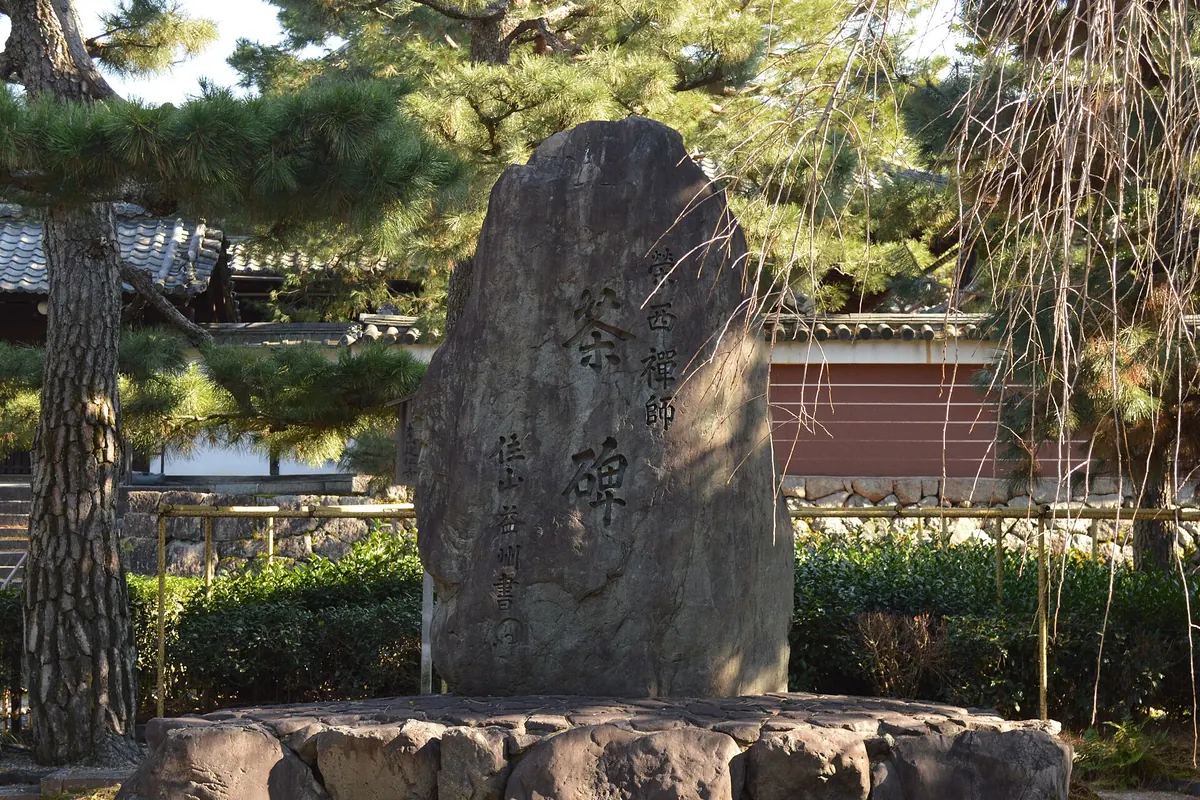
Eisai founded Kennin-ji in Kyoto in 1202 and is buried in its grounds, according to Wikipedia, which calls it a historic Zen temple and one of the Kyoto Gozan, the five most important Zen temples of Kyoto. Eisai also wrote Kissa Yōjoki, which Wikipedia renders as Drinking Tea for Health. He saw tea mainly as medicine, and Wikipedia records him offering a bowl of tea to the sick shogun Sanetomo. A stone monument at the temple commemorates tea.
Tea against drowsiness
Long hours of meditation are hard to stay awake through, and the Japanese tea ceremony article says plainly that Buddhists used tea to prevent drowsiness during them. That practical use is the earliest link between tea and temples, before any aesthetic or philosophy. It also explains why tea spread first among priests and the upper class. Japan-guide.com says tea reached Japan in the 8th century from China and was drunk as a medicinal beverage mainly among priests and the upper class, and that only in the Muromachi period did people of all classes take it up.
Zen and the shape of the ceremony
Japan-guide.com says a more refined version of tea parties developed around the Muromachi period with Zen-inspired simplicity and a greater emphasis on spirituality, and that the tea ceremony has its origins in those gatherings. Wikipedia credits Murata Jukō, an early developer of tea as a spiritual practice, with studying Zen under the monk Ikkyū. The ideals that came out of this are the ones guests still hear named today: wabi, a restrained and humble beauty, and the four principles harmony, respect, purity and tranquillity.
Rikyū and Daitoku-ji
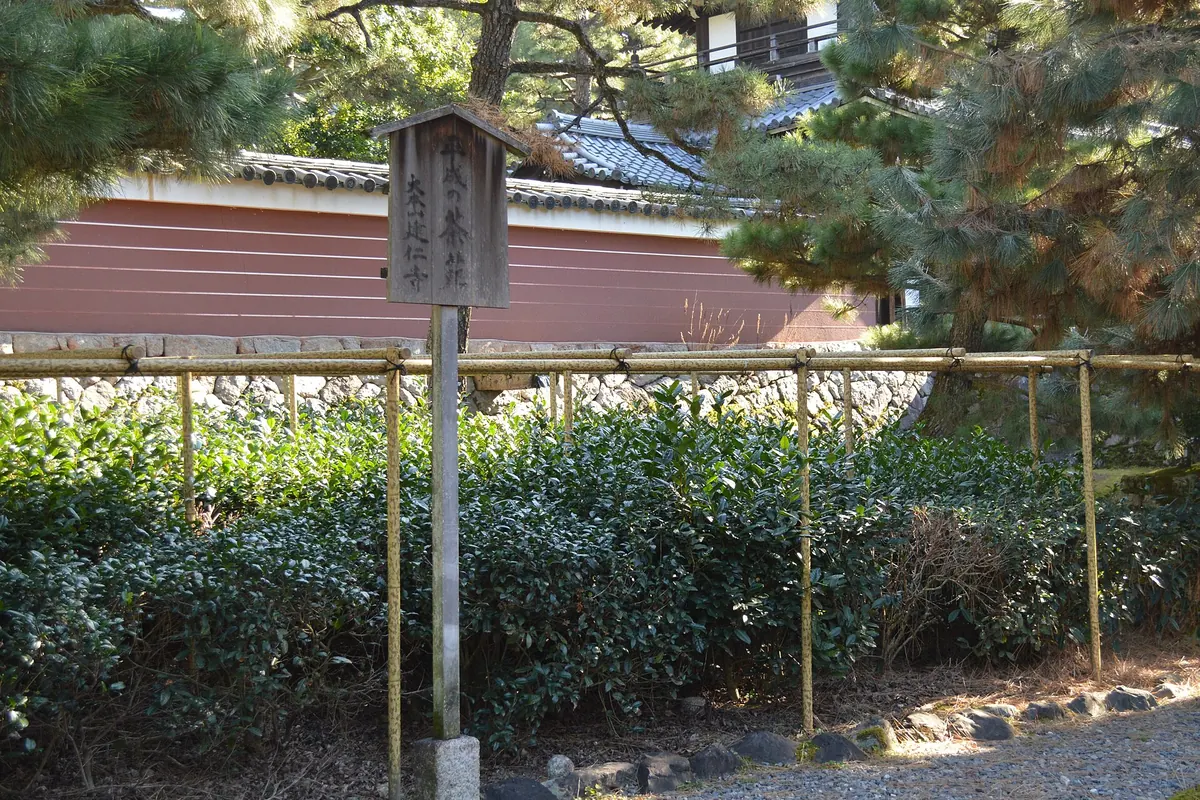
Wikipedia describes Sen no Rikyū (1522–1591) as the figure who shaped the tea ceremony more than any other, and says he underwent Zen training at Daitoku-ji in Kyoto. Daitoku-ji, a Rinzai Zen temple in the north of the city, is described there as having a deep connection with tea ceremony culture. The article adds that the main temple and many of its sub-temples are not open to the public. Rikyū preferred bokuseki, the calligraphy of Zen priests, for the scroll in the tearoom.
A tearoom borrows from temples and shrines
Not everything in tea comes from Zen. Wikipedia says the practice of purifying hands and mouth before the ceremony is influenced by the Shinto ritual of misogi, and that the gate between the tea garden and the everyday world draws on shrine architecture and the torii. It also says Zen Buddhism and Shinto together greatly influenced Japanese tea culture. The tokonoma, the alcove for a scroll and flowers, may derive from Zen monastery rooms of the Kamakura period, one of two theories Wikipedia sets out.
This temple is Pure Land, not Zen
Japanese Wikipedia lists Jōtoku-ji, the temple on this site's ticket, as a Jōdo-shū temple. Jōdo-shū, the Pure Land school, focuses on devotion to Amida Buddha and the recitation of his name, according to the English article, and it is a different school from Zen. So the Zen story above is the history of tea, not a claim about this room. What the temple setting does give you is a tea ceremony in a Buddhist site with a gate, grounds and a purification fountain, rather than a hotel function room.
Read next: Jōtoku-ji: the setting for the tea
Who this isn't for
If you want to sit in meditation, hear a Zen talk or visit a Zen monastery, this ceremony is not that. It is a 70-minute group workshop in the Grand Tearoom of a Pure Land temple. If the Zen history is what draws you, Kennin-ji and Daitoku-ji are the places to read about it, though Wikipedia notes that much of Daitoku-ji is closed to the public. For the ceremony itself, the tea ceremony etiquette guide on this site covers what to do with the bowl.
Read next: Tea ceremony etiquette, first time
Frequently asked questions
Is a Kyoto temple tea ceremony always Zen?
No. Tea has strong Zen links in history, but the temple on this ticket, Jōtoku-ji, is listed by Japanese Wikipedia as Jōdo-shū, the Pure Land school.
Who brought tea to Japan?
Wikipedia records the monk Eichū bringing tea from China in the 9th century and the monk Eisai introducing powdered tea and tea seeds around the end of the 12th century.
Why do monks drink tea?
Wikipedia says Buddhists used tea to prevent drowsiness during long meditations, and that powdered tea was first used in religious rituals in monasteries.
Sources